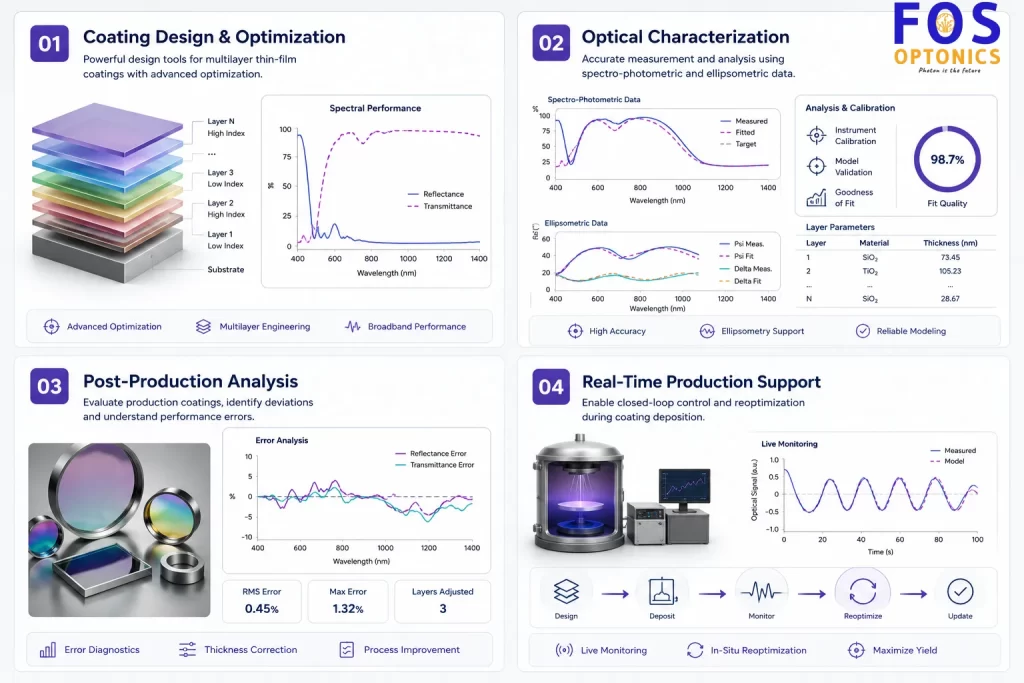
OptiLayer is an advanced thin film design and production software suite used for the design, analysis, characterization, and manufacturing optimization of multilayer optical coatings. It supports the full workflow from coating design and error analysis to monitoring strategy, production simulation, and post-production reverse engineering.
OptiLayer Key Capabilities
- Thin Film Coating Design & Optimization – Designs multilayer optical coatings for reflection, transmission, and filtering applications.
- Material Database & Modeling – Includes optical material libraries for accurate simulation and layer analysis.
- Spectral Analysis & Performance Evaluation – Simulates reflectance, transmittance, and absorption characteristics.
- Production-Oriented Workflow Support – Connects design and manufacturing for coating process optimization.
- Integration With Measurement Systems – Works with real-world instruments for validation and calibration.
The OptiLayer suite includes two integrated modules
OptiChar
Thin Film Characterization Module
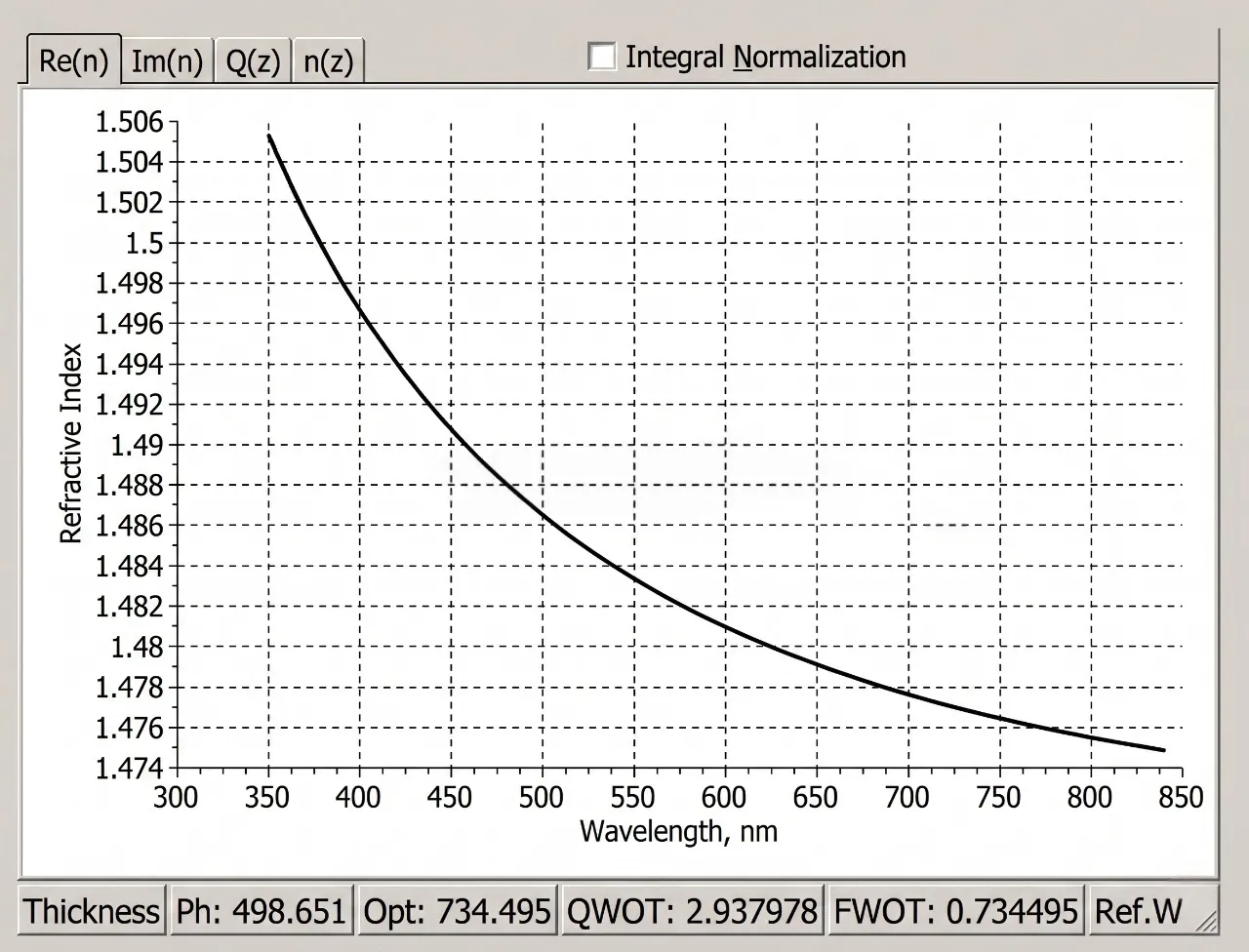
OptiChar is used for characterizing single-layer thin films from spectrophotometric and ellipsometric data. It supports dielectric films, metals, composites, ITO, TCO films, and mixtures. Unique strengths include:
- Non-parametric optical constant extraction
- Porosity modeling
- Bulk & surface inhomogeneity modeling
- Substrate characterization
- Effective medium theory models
It can import data from major spectrophotometers and ellipsometers and supports direct integration with production workflows.
OptiRE
Reverse Engineering & Production Feedback
OptiRE is designed for post-production multilayer analysis to help raise the quality of an optical coating production. It can detect:
- Systematic thickness errors
- Random thickness errors
- Refractive index drifts
- Layer inhomogeneity
- Measurement calibration drift
It supports:
- Multi-scan measurement analysis
- Online monitoring data
- Automation via COM interface
- Integration into deposition control software
This closes the feedback loop between design and production.

Together, OptiChar and OptiRE form a closed-loop workflow for optical coating design, characterization, and manufacturing control.
Why OptiLayer is Used?
OptiLayer is selected by thin-film engineers because it:
- Combines powerful mathematical algorithms with real manufacturing intelligence.
- Supports advanced coating design algorithms
- Allows analysis of thickness and index-related errors
- Helps estimate production yield before fabrication
- Simulates deposition behavior under real monitoring conditions
- Improves process stability and reduces test runs
Where OptiLayer is Used?
- Anti-reflection coatings
- High reflectors & dielectric mirrors
- Cold and hot mirrors
- Chirped and dispersive mirrors
- Edge filters, bandpass filters, and notch filters
- WDM filters
- Gain flattening filters
- Beamsplitters & polarizers
- Color coatings & dichroic filters
- Rugate and quasi-rugate coatings
- EUV and X-ray multilayers
OptiLayer Integration with Other Tools
- ZEMAX
- CODE V
- FRED
- OPTIS SPEOS
- OpTaLiX
Data can be exported in multiple formats including Excel, XML, PDF, and graphical formats.
The OptiReOpt DLL allows real-time embedding into deposition plant control systems, including LabVIEW environments.
Looking to evaluate OptiLayer for your next project?
Our experts can help you explore how OptiLayer fits your design and simulation needs.
Explore Related Solutions
CODE V Certification Training – Successfully Completed!🎉
FOS Optonics is pleased to announce the successful completion of the CODE V Certification Training – Basic…
OptoCompiler

RSoft CAD

OptSIM
Share this on: